
Healthcare SEO in 2026: Your Website Is Competing to Become the Answer
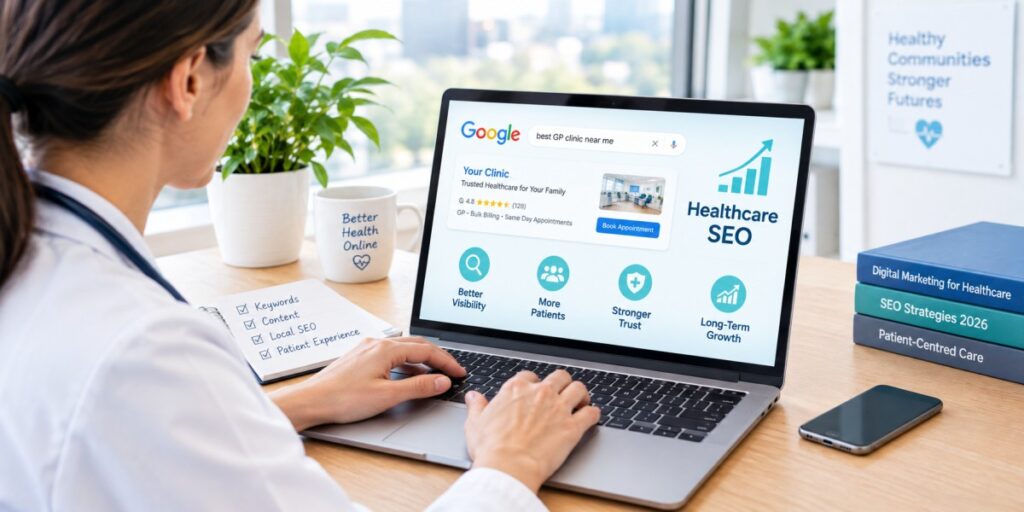
Healthcare SEO in 2026: Your Website Is Competing to Become the Answer For years, healthcare SEO had a familiar goal: rank on page one, earn the click and move the visitor towards a booking. That model is changing. Google’s AI Overviews have been available across Australia since October 2024, and AI Mode launched in Australia in October 2025. Instead of simply presenting a list of websites, Google can now synthesise information from multiple sources and answer increasingly complex questions directly inside Search. For healthcare providers, the implication is simple: visibility is no longer only about where your website ranks. It is also about whether your content is clear, credible and useful enough to be selected as a source. Why AI search changes healthcare marketing A 2026 study of 11,500 representative real-user queries found that Google generated AI Overviews for 51.5% of them. At the same time, research from Pew Research Center found that people were less likely to click traditional search results when an AI summary appeared: 8% of visits resulted in a traditional search-result click, compared with 15% when no AI summary was shown. That does not make SEO less important. Google’s own guidance for generative AI search says the opposite: foundational SEO practices still underpin visibility in AI Overviews and AI Mode. What has changed is the standard your content needs to meet. Healthcare websites are held to a particularly high bar because medical information can influence health decisions. Google describes health-related topics as “Your Money or Your Life” content and places additional emphasis on signals connected to experience, expertise, authoritativeness and trust. What makes a healthcare website easier to trust? Start with the questions patients and referrers actually need answered. A specialist website should make it easy to understand: what conditions or problems the clinic manages; which services and procedures are offered; who the practitioners are and their credentials; whether a referral is required; clinic locations, contact details and booking pathways; and what a patient or referring GP can expect next. This is useful for people, but it also gives search systems clearer information to interpret. Google specifically recommends unique, people-first content, logical page structure, crawlable websites and accurate local business information. It also warns against creating large volumes of generic content simply to manipulate search rankings. In healthcare, accuracy matters beyond SEO. Advertising and website content for regulated health services must also comply with Ahpra’s advertising requirements. That makes factual service pages, appropriately reviewed clinical content and accurate practitioner information far more valuable than exaggerated marketing claims. AI visibility and GP referrals are more connected than they look For specialist clinics, the website is not only a patient acquisition tool. It can also support the referral pathway. The Royal Australian College of General Practitioners highlights the importance of clear communication in specialist referrals and provides guidance to help GPs choose specialists and communicate referral intent. Imagine a GP, practice manager or patient searching: “Does this specialist treat this condition?” “Does this clinic accept referrals for this procedure?” “Which specialist near me manages this presentation?” If your website answers those questions clearly, consistently and credibly, it becomes more useful to both humans and search systems. That is the real opportunity of AI search. How clinics should respond in 2026 The answer is not to publish hundreds of AI-written articles or chase every new “GEO” hack. Google’s current guidance is much less dramatic: keep doing good SEO, but make your website genuinely useful. There is no special AI markup required to appear in Google’s generative search features. For healthcare businesses, that means building strong service pages, expert-led educational content, detailed practitioner profiles, useful FAQs, consistent local information and technically sound websites that Google can crawl and understand. It also means measuring more than rankings. Search visibility should ultimately support meaningful outcomes: relevant enquiries, referral relationships, branded searches and booked appointments. The next stage of healthcare search The clinics that perform well in search will not necessarily be the ones publishing the most content. They will be the ones providing the clearest and most trustworthy information. At Ambizcon, we help healthcare organisations build digital strategies around that shift — combining healthcare SEO, website strategy, content, local search and referral-focused marketing so practices can be found where patients and referrers are actually looking. Because in 2026, ranking is still important. But increasingly, the bigger question is: will your clinic be part of the answer?
AI in Healthcare: Practical use Cases for Clinics and Medical Centres

AI in Healthcare: Practical use Cases for Clinics and Medical Centres Artificial Intelligence (AI) is no longer a futuristic concept it’s already transforming how Australian clinics and medical centres operate every day. From streamlining administration to improving patient outcomes, AI offers practical benefits that can enhance care and boost efficiency. Below, we explore real world examples of how AI is being applied right now. 1. Automated Appointment Scheduling AI-powered booking systems can automatically schedule appointments, send reminders, and even predict no-shows. This saves valuable time for reception teams and reduces the risk of gaps in your appointment book. Example: Many Australian GP clinics use AI chatbots that allow patients to book or reschedule appointments 24/7, improving access and patient satisfaction. 2. Clinical Decision Support AI algorithms analyse patient data to assist with diagnosis and treatment planning. By comparing symptoms and test results to vast medical databases, AI tools can flag potential conditions clinicians may consider. Example: In radiology, AI can detect subtle changes in imaging studies, supporting earlier diagnosis and more accurate clinical decisions. 3. Streamlined Medical Documentation Voice recognition software powered by AI helps doctors transcribe consult notes quickly and accurately. This reduces paperwork burden, improves record-keeping, and allows clinicians to spend more time with patients. Example: Dictation tools like Dragon Medical One are widely adopted in Australian practices to create progress notes instantly. 4. Population Health Insights AI can identify patterns in large data sets to predict disease trends or highlight at risk patients. Clinics can use this information to plan preventive care campaigns or targeted outreach. Example: A medical centre might use AI analytics to identify patients overdue for chronic disease reviews, then generate reminders automatically. 5. Improved Patient Engagement AI chatbots and virtual assistants can answer common patient queries, provide health education, and guide patients through pre-appointment checklists. Example: Telehealth platforms increasingly integrate AI to triage symptoms and prepare patients before video consults. For Australian clinics and medical centres, adopting AI doesn’t mean replacing the human touch. Instead, it’s about using smart technology to improve workflows, reduce costs, and deliver better patient care. If you’d like help implementing AI solutions tailored to your practice, get in touch with our team today.